
In modern power systems, protection plays a major role in avoiding damage and blackouts. One essential protection method is Relay Co-ordination Study & Analysis. A power system comprises many electrical devices interconnected in various layers. These include generators, transformers, feeders, and loads. Protecting these components is very important.
In this blog, we explain how relay coordination works and how it prevents power system failures. We will also cover benefits, cost, and how to choose the right Relay Co-ordination Study & Analysis Service Provider.
What Is Relay Co-ordination Study & Analysis?
Relay Coordination Study and Analysis is a critical service in power system protection, especially in large and complex electrical networks. Protection relays and circuit breakers play a key role in safeguarding these systems. The objective is to ensure that any fault in the network is swiftly isolated without disturbing the healthy portions of the system.
When two protection devices are installed in a series arrangement and are configured to operate in a specific sequence, they are considered to be well-coordinated. Achieving this selective coordination is essential in designing a protection system that delivers fast, dependable, and precise fault isolation.
Purpose of Relay Coordination Study and Analysis
The primary goal of conducting a relay coordination study is to ensure that the protective devices operate correctly and safely, avoiding unnecessary tripping of non-faulted components. Many industries depend on these devices to maintain system reliability and operational safety. Incorrect or outdated settings—often altered during maintenance—can result in nuisance tripping, compromising system stability.
A well-executed coordination study ensures that only the minimum necessary portion of the electrical load is disconnected during faults or overloads. This analysis is essential to identify appropriate device ratings, characteristics, and settings to maximize protection without sacrificing service continuity.
When Should Relay Coordination Studies Be Performed?
Relay coordination analysis is recommended during:
- Initial design and planning stages of new electrical systems to pre-select appropriate protection devices.
- System upgrades or modifications, especially when adding new loads or components.
- Replacement of existing equipment with higher-rated or updated devices.
Key Steps in Relay Co-ordination Study & Analysis
A good Relay Co-ordination Study & Analysis service follows a detailed and step-by-step process.
Here are the main steps:
- Collect system data: Includes one-line diagrams, fault levels, and relay types.
- Model the power system: Use software to simulate the network.
- Perform short circuit analysis: Identify fault current levels at all nodes.
- Select relay settings: Based on time-current characteristics.
- Plot coordination curves: Ensure primary and backup relays operate in sequence.
- Validate results: Test the settings under different conditions.
This step-by-step process ensures accurate relay performance.
What Does a Relay Coordination Study Include?
Relay coordination studies follow industry standards such as ANSI/IEEE Std. 242 – 1986 (also known as the Recommended Practice for Protection and Coordination of Industrial and Commercial Power Systems).
These studies are typically software-based and use specialized programs for analyzing protection schemes. Key aspects of the study include:
- Short circuit analysis
- Time-current characteristic (TCC) curve evaluation
- Relay setting calculations
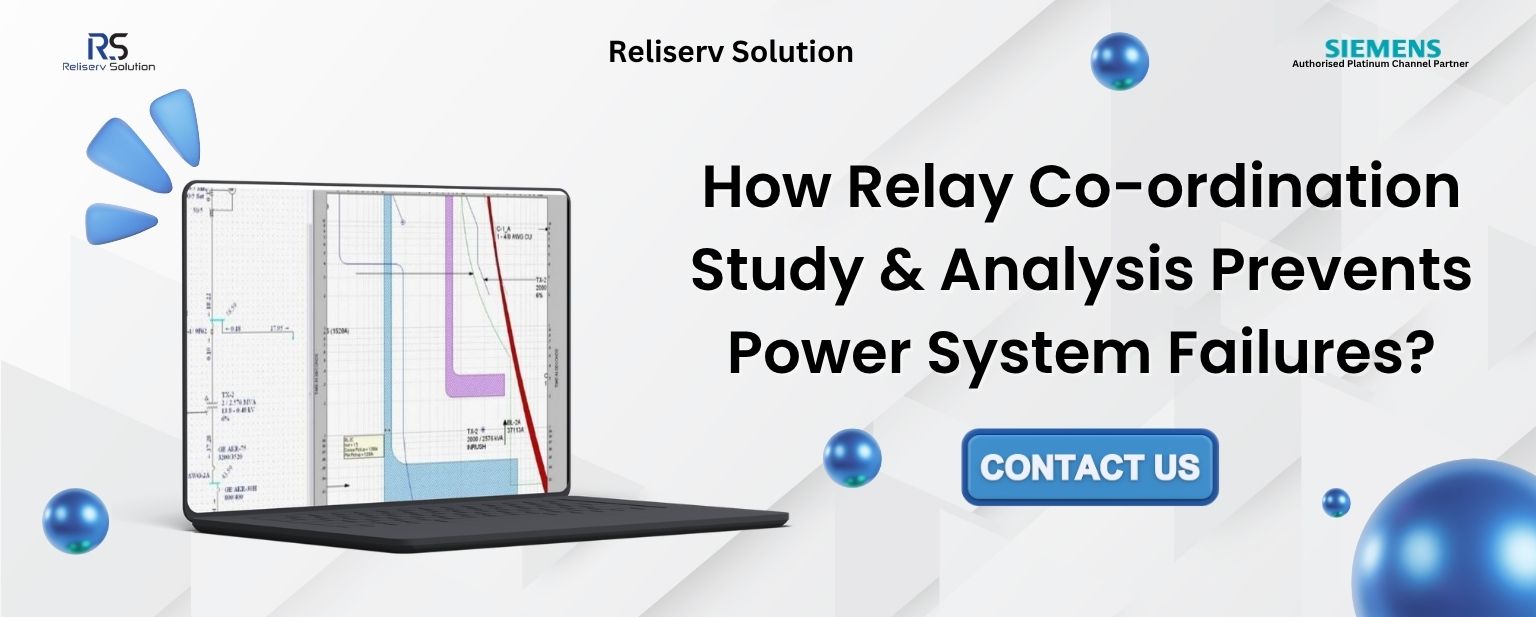
- Coordination diagrams and one-line schematics
Benefits of Relay Co-ordination Study & Analysis
Using Relay Co-ordination Study & Analysis offers many valuable advantages:
- Improves system reliability: Fewer outages and faster recovery.
- Reduces equipment damage: Trips the nearest breaker only.
- Increases system uptime: Healthy sections stay energized.
- Supports future expansion: Easier to add new loads or feeders.
- Fulfills safety norms: Meets utility or industrial standards.
These benefits make relay coordination a must-have study for modern grids.
Role of Relay Co-ordination Study & Analysis in Preventing Failures
A well-coordinated protection system avoids many types of failures. Here’s how it works in real scenarios:
- Short circuit faults: The Relay closest to the fault acts first.
- Transformer overloads: Thermal relays operate before transformer damage.
- Feeder faults: Breakers trip only the affected feeder, not the whole bus.
- Relay failure: Backup relay steps in without delay.
Each case shows the value of the Co-ordination Study & Analysis service in failure prevention.
Relay Co-ordination in Different Systems
This study is useful across various power networks:
- Industrial plants: Avoid full shutdowns during local equipment faults.
- Renewable systems: Protect solar and wind farms from grid disturbances.
- Distribution grids: Maintain service to unaffected areas during outages.
- Hospitals and data centers: Ensure continuous power to critical systems.
- Commercial buildings: Avoid unnecessary blackouts and loss of service.
In each setup, proper coordination helps keep the system stable and secure.
Relay Co-ordination Study & Analysis Service Cost
The Relay Co-ordination Study & Analysis service cost depends on many factors:
- Size of the electrical network.
- Number of relays and breakers.
- Complexity of system design.
- Type of software used.
- On-site vs. remote support required.
- Report format and certification needs.
Understanding these factors helps estimate the service cost accurately.
Choosing a Relay Co-ordination Study & Analysis Service Provider
Not all providers deliver the same quality. Choosing the right Relay Co-ordination Study & Analysis Service Provider is important.
Look for the following qualities:
- Technical expertise: Engineers should understand protection systems well.
- Software proficiency: Use of tools like ETAP, PowerWorld, or DIGSILENT.
- Industry experience: Providers should have experience with similar projects.
- Quick turnaround: Timely delivery of study reports is important.
- Support services: Include site support, relay setting uploads, and testing.
- Certified professionals: Compliance with electrical codes and standards.
A good provider improves safety and protects valuable infrastructure.
Real-World Example
An industrial facility faced frequent outages due to protection relay issues. Breakers tripped even when faults occurred far away.
After hiring a Relay Co-ordination Study & Analysis Service Provider, they optimized relay settings.
The result:
- Fewer power trips.
- Faster fault clearance.
- Improved equipment protection.
This case shows the value of relay coordination in practice.
Relay Co-ordination and Safety Compliance
Many industries must follow local or global safety standards. These include:
- IEEE protection standards.
- IEC relay operation rules.
- Factory Acceptance Test (FAT) protocols.
- Utility grid codes.
A complete coordination study & Analysis ensures these standards are met. This helps avoid penalties and improves plant safety.
Automation and Future Scope
Relay coordination is not just for old systems. It also supports smart grid evolution.
Here’s how:
- Digital relays can store multiple setting groups.
- SCADA integration allows real-time monitoring.
- IoT devices offer live fault tracking.
- Remote updates can modify relay settings instantly.
These trends make relay coordination more flexible and powerful.
Summary of Key Points
Let’s summarize what we have learned:
- It prevents system-wide failures.
- It helps isolate faults and protect valuable equipment.
- Relays must be set with correct curves and timings.
- Its service is needed for safe operation.
- The Relay Co-ordination Study & Analysis service cost varies by system complexity.
- Choosing a trusted Relay Co-ordination Study & Analysis Service Provider ensures quality results.
- It supports both current needs and future smart grid upgrades.
Conclusion
Relay protection is vital for every power system. But without coordination, even the best relays can cause problems. That’s why Relay Co-ordination Study & Analysis is so important. It ensures relays operate in the right order and at the right time.
A good coordination study & analysis service improves safety, reliability, and performance. It also reduces the chance of total system blackouts.
Understand the Relay Co-ordination Study & Analysis service cost and hire the right Relay Co-ordination Study & Analysis Service Provider. This investment will protect your power network for years to come. Choose coordination, safety, and smarter power system management.
Reliserv Solution is a leading distributor and supplier of Power System Studies and a Platinum Channel Partner of Siemens. The organization, which has its headquarters in Mumbai, Maharashtra, provides a wide range of services and customized solutions for panel builders and other industrial sectors. For any inquiries or help with the Relay Co-ordination Study & Analysis, please contact us via phone at +91 7506112097 or by email at [email protected]. Click here to learn more about one of the Power System Studies.