Every year, utilities and industries lose valuable operating hours because protection systems fail to isolate faults quickly enough. A delayed trip can destroy transformers, obliterate switchgear, and bring entire production lines to a halt in seconds. Protection engineers understand that reliable fault clearance is not simply a technical requirement anymore; it has become a business necessity.
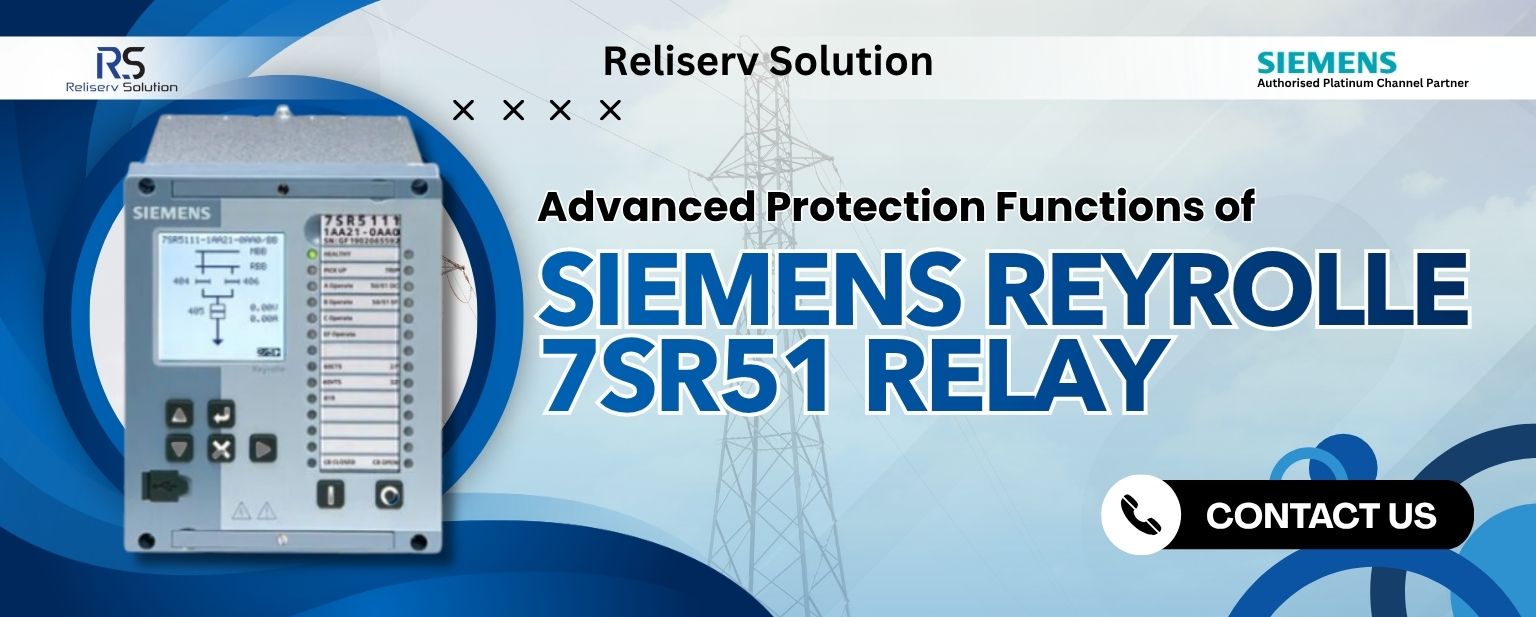
This is exactly where the 7SR51 Overcurrent Protection Relay proves its value. Designed for feeder and backup protection applications, the relay combines advanced protection functions, event recording, communication capabilities, and automation support inside a compact numerical platform. Instead of relying on multiple standalone devices, operators can manage several protection tasks through one intelligent relay.
The Siemens Reyrolle 7SR51 Protection Relay has therefore become a preferred choice for utilities, industries, renewable energy projects, and infrastructure applications. Its flexibility allows engineers to protect feeders, transformers, cables, and distribution systems while maintaining high levels of reliability and selectivity.
Why Conventional Overcurrent Protection Is No Longer Enough
Traditional overcurrent relays performed one basic task very well. They detected abnormal current levels and issued a trip command. However, today’s electrical networks present much more complicated operating conditions.
Industrial facilities operate with varying load patterns throughout the day. Distribution networks increasingly include renewable generation sources. Ring networks allow power flow in multiple directions, while modern substations demand remote monitoring and real-time diagnostics.
Under these conditions, a simple overcurrent relay may struggle to provide adequate protection coordination.
The 7SR51 Overcurrent Protection Relay addresses these challenges by combining multiple protection elements with intelligent communication and automation features. As a result, operators gain faster fault isolation, improved selectivity, and better visibility into network performance.
What Makes the Siemens Reyrolle 7SR51 Protection Relay Different?
Most conventional relays focus primarily on fault detection. The Siemens Reyrolle 7SR51 Protection Relay, however, takes a much broader approach by integrating protection, control, monitoring, and communication functions within one device.
This approach reduces panel complexity while improving operational efficiency.
The relay offers:
- Phase overcurrent protection.
- Earth fault protection.
- Directional protection functions.
- Breaker failure protection.
- Thermal overload monitoring.
- Event and disturbance recording.
- Multiple communication protocols.
- Integrated control functionality.
Because these functions exist within a single platform, utilities can reduce engineering effort and simplify maintenance activities significantly.
How Does the Relay Improve Overcurrent Protection?
Overcurrent faults remain one of the most common causes of equipment damage in electrical systems. Fault currents rise rapidly and can generate severe thermal and mechanical stress within transformers, cables, and switchgear.
The 7SR51 Overcurrent Protection Relay detects these conditions immediately and isolates the faulted section before permanent damage occurs.
The relay supports several protection characteristics, including:
- Instantaneous overcurrent protection.
- Definite time overcurrent protection.
- Inverse time overcurrent protection.
- User-defined protection curves.
Why does this flexibility matter?
Different applications require different protection philosophies. Transformer protection schemes often require inverse characteristics for coordination purposes, while busbar protection applications may demand instantaneous operation.
The relay allows engineers to configure these settings according to system requirements rather than adapting the network around the relay’s limitations. As a result, coordination studies become easier, and protection performance improves.
Why Is Directional Protection Becoming More Important?
Previously, electrical power flowed in one direction only from the utility source to the customer load. Today, renewable generation, captive power plants, and distributed energy resources allow power to flow in multiple directions.
The Siemens Reyrolle 7SR51 Protection Relay addresses this challenge through directional overcurrent protection functions. The relay determines both the magnitude and direction of fault current before issuing a trip command.
This provides several important benefits:
- Improved fault discrimination.
- Better coordination between protection zones.
- Reduced unnecessary outages.
- Enhanced reliability in ring networks.
Earth Fault Protection That Detects Problems Early
Many serious equipment failures begin as small insulation breakdowns or minor leakage currents. If these faults remain undetected, they often develop into larger failures that require expensive repairs.
The 7SR51 Overcurrent Protection Relay includes comprehensive earth fault protection functions designed to detect these conditions early.
The relay supports:
- Definite time earth fault protection.
- Inverse time earth fault protection.
- Sensitive earth fault protection.
- Directional earth fault protection.
Why is this important for operators?
Early fault detection allows maintenance teams to intervene before major failures occur. Consequently, equipment life increases while maintenance costs decrease.
This proactive protection philosophy helps utilities improve network reliability while reducing unplanned outages.
Thermal Protection Extends Equipment Life
Electrical equipment naturally generates heat during operation. However, prolonged overload conditions can cause temperatures to rise beyond safe operating limits. Motors, transformers, and cables are particularly vulnerable to thermal damage.
The Siemens Reyrolle 7SR51 Protection Relay continuously monitors thermal conditions and calculates equipment heating based on real-time operating data.
When temperatures approach dangerous levels, the relay provides alarms or initiates protective action automatically.
This capability helps operators:
- Prevent insulation deterioration.
- Extend equipment life.
- Reduce maintenance expenses.
- Improve asset utilisation.
How Does Breaker Failure Protection Improve Reliability?
However, mechanical failures occasionally prevent breakers from opening after receiving a trip command. When this happens, the fault remains connected to the network for longer than expected.
The Siemens Reyrolle 7SR51 Protection Relay includes breaker failure protection functions that detect unsuccessful breaker operations and initiate backup tripping sequences automatically.
This additional layer of protection:
- Reduces fault duration.
- Protects adjacent equipment.
- Improves personnel safety.
- Increases overall network reliability.
Although breaker failures occur infrequently, their impact can be significant. Therefore, backup protection remains an essential feature in modern substations.
Communication and SCADA Integration
Modern substations expect protection relays to communicate seamlessly with automation systems. Protection devices that cannot exchange information quickly create operational blind spots during fault conditions.
The Siemens Reyrolle 7SR51 Protection Relay supports several communication protocols that simplify SCADA integration.
These include:
- IEC 61850.
- Modbus.
- DNP3.
- IEC communication standards.
This communication capability allows operators to:
- Monitor relay status remotely.
- Retrieve fault information instantly.
- Perform diagnostics from control centres.
- Improve system visibility.
Event Recording and Disturbance Analysis
Finding the root cause of an electrical fault often proves difficult without accurate event information. Modern utilities therefore expect relays to act as both protection devices and diagnostic tools.
The 7SR51 Overcurrent Protection Relay records:
- Fault reports.
- Event logs.
- Sequence of events information.
- Disturbance records.
These records allow engineers to analyse system behaviour before, during, and after fault conditions. Instead of relying on assumptions, maintenance teams can identify the exact sequence of events and implement corrective actions quickly.
Engineering and Commissioning Advantages
Complex protection systems often increase engineering effort and commissioning costs. The Siemens Reyrolle 7SR51 Protection Relay reduces these challenges through flexible configuration and simplified engineering tools.
Engineers benefit from:
- Easy parameter setting.
- Flexible protection logic.
- Faster testing procedures.
- Simplified commissioning activities.
Understanding Siemens 7SR51 Protection Relay Price
Procurement teams naturally evaluate cost before selecting any protection device. However, focusing solely on the purchase price often produces misleading conclusions. The Siemens 7SR51 Protection Relay Price depends on several factors, including communication options, input and output configuration, and project-specific requirements.
A more useful approach considers total ownership cost rather than initial purchase price alone. Reduced downtime, improved protection coordination, and lower maintenance requirements frequently generate savings that exceed the initial investment.
Therefore, organisations should evaluate operational value alongside the Siemens 7SR51 Protection Relay Price before making procurement decisions.
Choosing the Right Siemens 7SR51 Protection Relay Supplier
An experienced Siemens 7SR51 Protection Relay Supplier provides technical guidance, configuration support, and commissioning expertise that improve project outcomes significantly.
When evaluating a Siemens 7SR51 Protection Relay Supplier, organisations should consider:
- Technical product knowledge.
- Application expertise.
- Local support capability.
- Spare parts availability.
- After-sales service quality.
A knowledgeable Siemens 7SR51 Protection Relay Supplier helps customers avoid configuration mistakes that may lead to future reliability problems.
Conclusion
The 7SR51 Overcurrent Protection Relay delivers much more than conventional overcurrent protection. Its advanced protection functions, communication capabilities, disturbance recording features, and automation support make it an important part of modern electrical infrastructure. Whether protecting industrial feeders, utility substations, or renewable energy installations, the relay provides the speed, accuracy, and flexibility required by today’s networks.
The Siemens Reyrolle 7SR51 Protection Relay continues to support utilities and industries seeking higher reliability and improved operational performance. As power systems become increasingly digital and interconnected, intelligent protection devices such as the 7SR51 Protection Relay will play an even greater role in maintaining system stability, reducing downtime, and protecting critical electrical assets.
Enhance the safety and reliability of your electrical network with the Siemens Reyrolle 7SR51 Relay. Designed with advanced overcurrent and feeder protection functions, it delivers fast fault detection, selective tripping, and dependable system protection, helping utilities and industries minimize downtime and improve operational continuity. At Reliserv Solution, a Platinum Channel Partner of Siemens, we provide advanced protection solutions tailored to modern power system requirements. Call us at +917506112097 or email [email protected] for expert guidance and support. Click here to explore the 7SR51 Overcurrent Protection Relay and discover how its advanced protection functions improve power system safety, reliability, and performance.