Every substation has one job: to keep power flowing without letting faults destroy equipment. Circuit breakers are the devices that make that possible. But here is the thing, most people outside the industry do not fully appreciate: installing a circuit breaker is not the same as having a working circuit breaker.
That gap between installation and actual reliable operation is exactly what Circuit Breakers Commissioning fills.
This blog explains what commissioning involves, why it directly affects how your power system behaves during a fault, and what to look for when you need professional help.
A Circuit Breaker Is Not Plug-and-Play
People sometimes assume that a new breaker from a good manufacturer will just work. That assumption causes real problems.
Breakers travel from factories to warehouses to project sites. Things shift during transport. Connections loosen. Settings get altered. Insulation picks up moisture. None of this is visible from the outside.
And even if the breaker arrives in perfect condition, it still needs to be set up correctly for your specific system. The coil voltage, the trip settings, and the protection relay interface — these are not generic. They are specific to your installation.
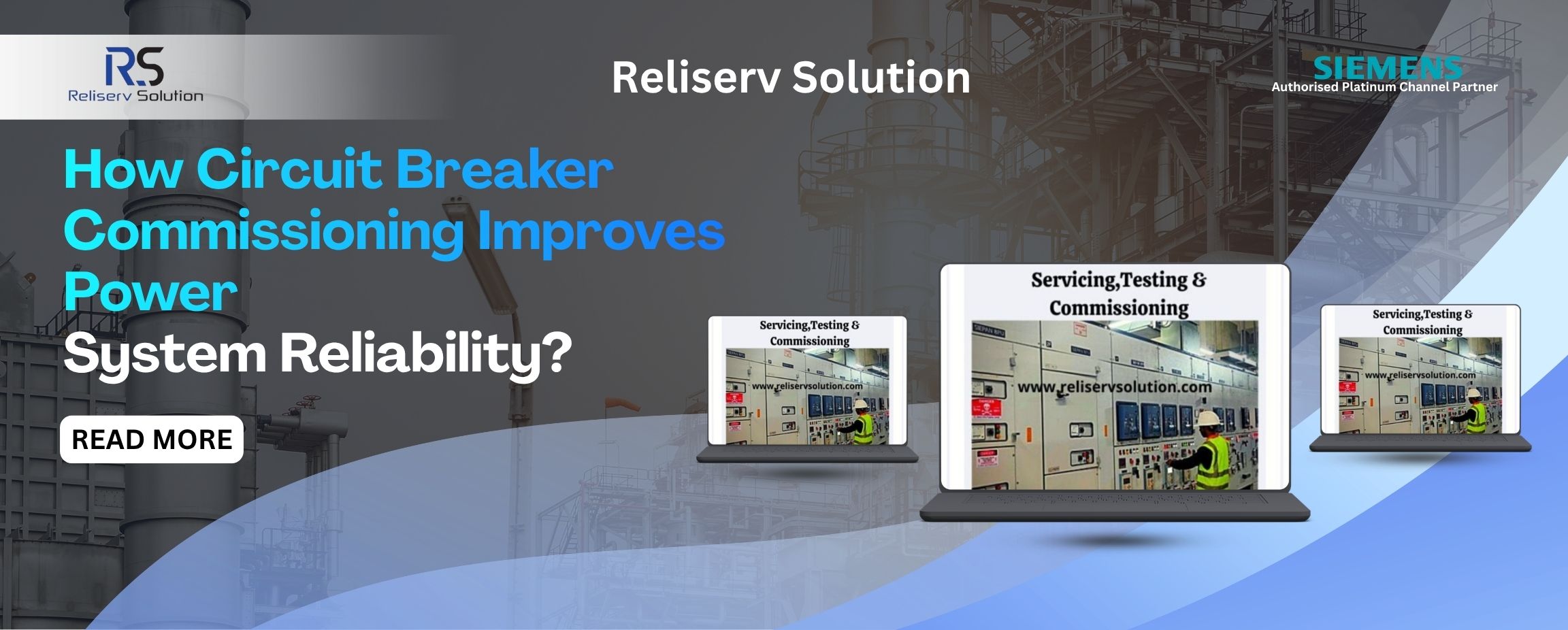
Circuit Breakers Commissioning is the process that closes this gap. It tests, verifies, and documents the breaker’s behaviour before the system goes live. If something is wrong, you find it on the test bench — not during a fault at 2 am.
Why the Timing Test Matters More Than People Think?
Of all the commissioning tests, the timing test gets overlooked most often. It should not be.
A circuit breaker that takes too long to open lets fault current flow for longer than it should. That extra time — sometimes just a few milliseconds — can mean the difference between a tripped breaker and a destroyed transformer.
Protection engineers design systems around expected breaker operating times. If the breaker is slower than expected, the protection scheme does not perform as designed. The entire fault clearance calculation falls apart.
This is why commissioning timing results must be compared against the manufacturer’s factory test certificate. Not roughly compared. Exactly compared. Any significant deviation needs investigation before the breaker goes into service.
Circuit Breakers Servicing: The Work That Keeps Reliability Alive
Commissioning is a one-time event at the start of a breaker’s life. Circuit Breaker servicing is what keeps it reliable for the years that follow.
Breakers age. Contacts wear down with every operation. Lubricants dry out. Springs lose tension over time. Control wiring terminals corrode. These changes happen slowly and silently. Regular servicing catches them before they become failures.
A structured Circuit Breakers Servicing programme typically includes:
- Repeat timing tests to detect any slowing in mechanical operation
- Contact resistance checks to monitor wear on the main contacts
- Lubrication of all moving mechanical parts
- Cleaning of arc chutes, insulators, and contact surfaces
- Control circuit checks, including trip coil resistance measurement
- Protection relay re-testing to confirm settings have not drifted
- Visual inspection for corrosion, contamination, or mechanical damage
Most plants service high-priority breakers every one to three years. Lower-priority units may be on a five-year cycle. The right interval depends on the breaker type, its operating frequency, and its criticality in the network.
What matters most is that servicing is not skipped. An unserviced breaker is an untested breaker. And an untested breaker is a risk.
How Commissioning and Servicing Connect
Here is something that gets missed when these two activities are treated separately.
The commissioning record is not just paperwork. It is a reference document that makes every future Circuit Breakers Servicing visit more useful.
During servicing, engineers compare current test results against the original commissioning baseline. If contact resistance was 45 microohms at commissioning and is now 120 microohms, that tells a clear story. The contacts are wearing. Action is needed.
Without a commissioning baseline, the servicing engineer has no reference point. They can only compare results against the manufacturer’s published limits, which are fairly wide.
What Proper Commissioning Does for Your Power System
The practical impact of thorough Circuit Breakers Commissioning shows up in measurable ways:
- Faults are cleared faster because breakers operate within their specified times
- Unexpected outages are reduced because problems are caught before the breaker goes live
- Equipment lasts longer because servicing is guided by accurate baseline data
- Workers stay safer because breakers respond correctly during fault conditions
- Insurance and compliance requirements are met with proper documentation
None of this is theoretical. Every site that skips commissioning is betting that nothing will go wrong. Some win that bet. Many do not.
Choosing the Right Circuit Breakers Commissioning Service Provider
This work requires trained engineers with the right equipment and the right knowledge. Choosing the wrong Circuit Breakers Commissioning Service Provider gives you a test report without genuine assurance.
When evaluating a Circuit Breakers Commissioning Service Provider, check for:
- Experience with your specific breaker type — Vacuum, SF6, and air-blast breakers each have their own test procedures. A provider should know the difference.
- Calibrated test equipment — Results from uncalibrated equipment are unreliable. Ask when instruments were last calibrated.
- Detailed written reports — Every test, every result, every deviation should be documented. Verbal confirmation is not enough.
- Protection relay knowledge — Commissioning does not stop at the breaker terminals. The trip circuit and relay interface must also be verified.
- Safety procedures — Working near high-voltage equipment carries real risk. Your provider’s safety record and procedures matter.
The right Circuit Breakers Commissioning Service Provider understands that they are not just completing a checklist. They are setting up the safety foundation for your entire power system.
Understanding Circuit Breakers Commissioning Cost
Circuit Breakers Commissioning Cost is one of the first questions clients ask. It is also one of the most misunderstood.
Several factors affect Circuit Breakers Commissioning Cost:
- Voltage level and breaker type — HV breakers take more time and specialised equipment
- Number of breakers — More units increase time and therefore cost
- Protection scheme complexity — Complex schemes with multiple relay interfaces take longer to test
- Site location — Remote sites add travel and logistics expenses
- Documentation requirements — Detailed client reports require more engineer time
Here is the honest reality about Circuit Breakers Commissioning Cost: it is almost always small compared to what a single breaker failure costs.
A failed transformer replacement runs into crores. A plant shutdown for even one day loses significant production. An injury from an untested breaker has costs that cannot be measured in money alone.
Conclusion
A circuit breaker that has not been properly commissioned is an unknown quantity. It may work. It may not. You will only find out during a fault, which is the worst possible time for surprises.
Circuit Breakers Commissioning removes that uncertainty. It tests the breaker against real conditions, documents what it finds, and gives you a solid baseline for everything that follows.
Circuit Breakers Servicing then builds on that foundation. It keeps the breaker in good working condition across years of operation, using the commissioning record to detect changes before they become failures.
Reliserv Solution is an authorized provider of Circuit Breakers Servicing, Testing & Commissioning. The company’s headquarters are located in Mumbai, Maharashtra. We offer a variety of services and customized solutions to numerous industries, including panel builders. Call us at +917506112097 or shoot us an email at [email protected] if you need assistance or have any questions. Click here to view the popular Field Service, Circuit Breakers Servicing, Testing & Commissioning.