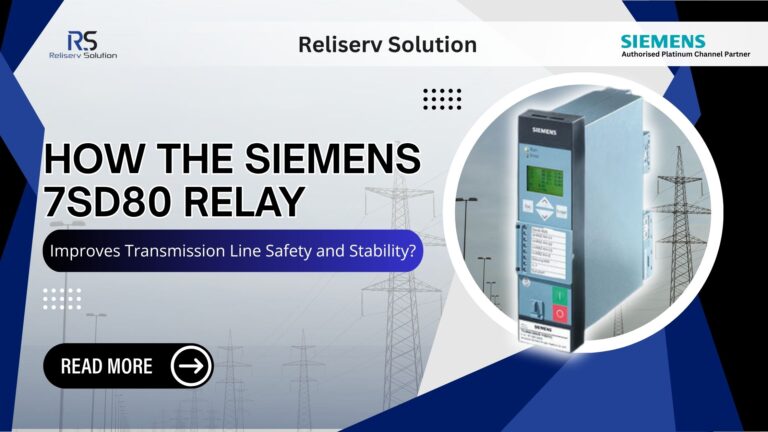
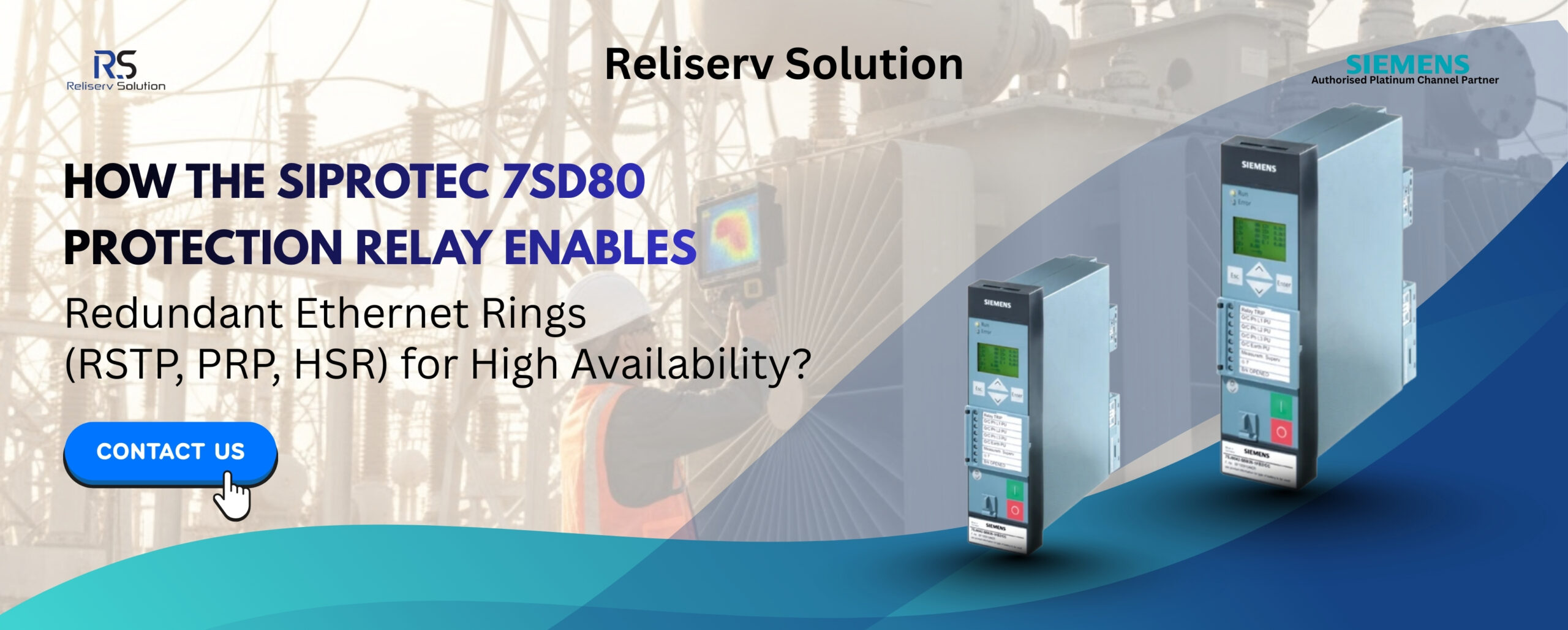
Power system protection depends on fast and reliable communication. In modern substations, protection relays must exchange data without delay. Any communication failure can lead to wrong decisions or delayed tripping. This risk increases as networks become more digital and interconnected. High-availability communication is no longer optional. Utilities and industries require systems that continue to operate even during network faults. This requirement has pushed protection devices to support advanced redundancy protocols. One relay designed with this goal is the SIPROTEC 7SD80 Protection Relay.
This relay combines advanced protection functions with strong Ethernet redundancy support. It ensures uninterrupted communication using RSTP, PRP, and HSR networks. These features help maintain system stability under challenging conditions.
Role of the Siemens SIPROTEC 7SD80 Protection Relay in Modern Substations
The Siemens SIPROTEC 7SD80 Protection Relay is designed for line differential protection. It also supports modern Ethernet communication. This combination makes it ideal for digital substations.
The relay integrates seamlessly into redundant Ethernet networks. It supports RSTP, PRP, and HSR without external devices. This reduces system complexity and wiring effort.
Built-in redundancy improves reliability and simplifies engineering.
Why High Availability Matters in Protection Networks
Protection relays operate in real time. They depend on fast data exchange between bays, substations, and control centers. A single network failure can block critical messages. This can delay fault isolation or create unsafe conditions.
Redundant Ethernet rings solve this challenge. They provide alternate communication paths automatically. When one path fails, traffic moves instantly to another route. This ensures protection functions remain active.
High-availability networks protect not only equipment but also people. They reduce blackout risks and improve grid confidence.
Understanding Ethernet Redundancy in Substations
Ethernet redundancy allows continuous communication despite failures. Different protocols achieve this in different ways. Modern protection relays support multiple redundancy standards.
The most common redundancy methods include:
- RSTP for loop prevention and fast recovery
- PRP for zero-time recovery using parallel networks
- HSR for ring-based zero-time recovery
Each method serves specific network designs. Advanced relays support multiple options for flexibility.
How RSTP Enhances Network Stability
Rapid Spanning Tree Protocol prevents Ethernet loops. It allows network redundancy while avoiding broadcast storms. When a link fails, RSTP quickly recalculates the path.
The relay supports RSTP to maintain stable communication. It helps detect topology changes and adapts automatically. This ensures protection of data continues to flow with minimal delay.
RSTP suits traditional star and ring network structures.
Benefits of PRP for Zero-Time Recovery
The Parallel Redundancy Protocol uses two independent networks. Each device sends duplicate frames through both paths. The receiver accepts the first frame and discards duplicates.
PRP offers zero recovery time. Communication continues even during a complete network failure. The SIPROTEC 7SD80 Protection Relay supports PRP natively.
This makes it ideal for critical transmission lines where downtime is unacceptable.
HSR for Ring-Based High Availability
High-availability Seamless Redundancy works in ring topologies. Each node forwards frames in both directions. If a link fails, data still reaches its destination.
HSR provides zero-time recovery without switches. This reduces equipment count and simplifies layouts. The relay integrates HSR for compact substation designs.
HSR is useful for process bus and bay-level communication.
Why Built-In Redundancy Matters
External switches can provide redundancy. However, built-in support offers better coordination. It reduces latency and configuration effort.
The relay handles redundancy internally. This ensures faster switchover and fewer failure points. Engineers gain a cleaner and more reliable design. Integrated redundancy supports long-term network stability.
Supporting Digital Substation Architectures
Digital substations rely on Ethernet communication. Protection, control, and monitoring share the same network. This increases efficiency but also raises dependency on communication.
The Siemens SIPROTEC Relay family supports IEC 61850 standards. The 7SD80 fits perfectly into this environment. Redundant networking ensures data availability at all times.
This supports modern protection philosophies and automation goals.
Improving Protection Performance Through Reliability
Communication failures can delay differential protection decisions. This increases fault-clearing time. Longer clearing times can damage equipment.
Reliable Ethernet redundancy ensures that protection messages arrive instantly. The relay maintains synchronization between line ends. This improves accuracy and speed.
Reliable networks directly enhance protection performance.
Human Impact of High Availability Systems
Reliable systems reduce stress for operators. Unexpected communication faults create panic and confusion. High-availability networks prevent such scenarios.
Operators trust systems that continue working during faults. Maintenance teams work with confidence. This improves morale and operational discipline.
Stable networks support people as much as machines.
Ease of Engineering and Configuration
Complex networks increase engineering effort. Built-in redundancy simplifies design. Engineers configure redundancy using familiar tools.
The relay supports flexible network topologies. It adapts to existing infrastructure easily. This reduces commissioning time and errors. Simplified engineering saves both time and cost.
Long-Term Cost Benefits
High-availability systems may cost more initially. However, they reduce long-term operational losses. Downtime costs often exceed equipment costs.
Reliable networking minimizes outages and penalties. It improves asset utilization and service continuity. This makes redundancy a smart investment.
Why Genuine Products Matter
Network performance depends on genuine hardware. Counterfeit devices may not support redundancy correctly. This creates hidden risks.
Trusted SIPROTEC 7SD80 Relay Suppliers in Mumbai provide authentic equipment. They also offer technical guidance and after-sales support. Reliable sourcing protects your investment.
Understanding Pricing Value
The SIPROTEC 7SD80 Relay Price reflects advanced features and reliability. It includes protection, communication, and redundancy capabilities.
When compared with downtime costs, the price becomes justified. One avoided outage can recover the investment.
Value lies in performance, not only purchase cost.
Key Advantages of Ethernet Redundancy
Redundant Ethernet support offers many benefits:
- Zero communication downtime
- Faster fault clearing
- Improved protection accuracy
- Reduced operational stress
- Higher system availability
These advantages support modern grid demands.
Future-Ready Protection Strategy
Power systems are evolving rapidly. Renewable integration increases network complexity. Communication reliability becomes even more critical.
Relays with built-in redundancy prepare systems for future challenges. They support scalable and flexible designs. This future-proofs protection investments.
Conclusion
High-availability communication is essential for modern protection systems. Ethernet failures can no longer be tolerated in critical substations. Redundant networks ensure continuous data flow during faults.
The SIPROTEC 7SD80 Protection Relay enables robust redundancy using RSTP, PRP, and HSR. It’s built-in support simplifies design and improves reliability. Choosing trusted SIPROTEC 7SD80 Relay Suppliers in Mumbai ensures genuine performance and support.
Although the SIPROTEC 7SD80 Relay Price reflects premium capabilities, the long-term benefits outweigh the cost. Reliable communication protects assets, people, and grid stability. This makes the relay a strong choice for high-availability power systems.
Reliserv Solution, a Siemens Platinum Channel Partner, provides Siemens Numerical Relays. The company’s headquarters are located in Mumbai, Maharashtra. We also offer a range of services and customized solutions to panel builders and other industries. If you need assistance or have any questions, please call us at +91 7506112097 or send an email to [email protected]. Click here to view Siemens Numerical Relays’ popular SIPROTEC 7SD80 Protection Relay.