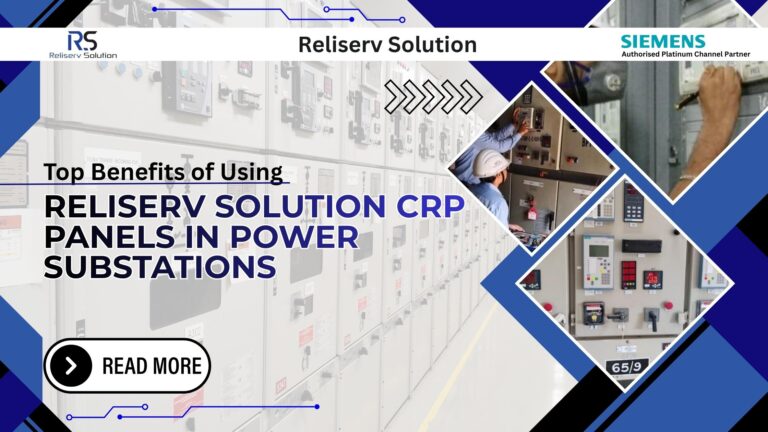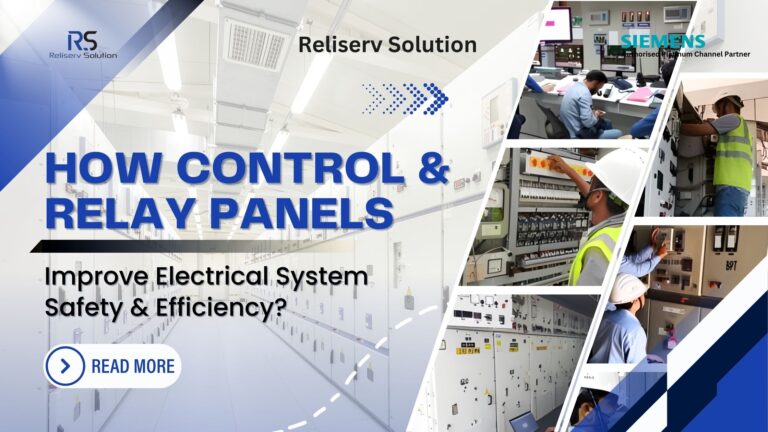
Every 11KV and 33KV substation depends on one silent hero: the panel that reacts in milliseconds when a fault strikes. Behind that reliability sits a Control & Relay Panels setup, quietly protecting transformers, generators, and feeders around the clock.
A Control Relay Panel solution brings protection, control, and monitoring together in one compact unit for a substation. It houses relays, meters, and switches that safeguard equipment and keep power flowing, even during faults.
Reliserv Solution has spent more than a decade building these systems for utilities and industries across India. This blog explains how modern Control & Relay Panels work and why they matter. It also covers how procurement teams should plan budgets, timelines, and supplier selection for their next project.
What Is a Control & Relay Panel?
A control panel is an enclosure housing relays, meters, switches, and wiring. This design is essential because it centralizes protection for switchgear that lacks built-in space of its own. It controls the associated line or transformer through outdoor switchgear at 11KV and 33KV zonal substations.
These panels are complete in themselves. They include main and auxiliary relays, annunciation relays, fuses, links, and terminal blocks. Earthing terminals, base frames, and cable glands are also wired and labeled at the factory.
What makes this design valuable is flexibility. The same core structure adapts to single-circuit or multi-circuit configurations. This depends on the substation’s size and the number of feeders involved.
- Protection, control, and monitoring in a single enclosure
- Suitable for single-circuit or multi-circuit configurations
- Deployed for transformers, generators, motors, and feeders
- Includes labels, illumination, and foundation bolts.
Why Do Substations Need a Control Relay Panel Solution?
Modern substations demand faster fault response and safer conditions for field engineers. A Control Relay Panel solution is typically deployed when switchgear cannot accommodate protection and monitoring equipment on its own.
Furthermore, this approach keeps live switchgear exposure to a minimum. Engineers can operate, test, and monitor equipment from a safe distance instead of standing near energized busbars.
Why does this matter so much today? Substations are being asked to run leaner teams while managing more connected equipment than ever before.
- Reduces exposure to live switchgear for on-site safety
- Enables substation HMI, metering, and networking in one system
- Avoids the added cost of a separate control room
- Supports remote diagnostics for faster fault response
- Simplifies audits and compliance checks with organized documentation
Key Features of Reliserv Solution’s CRP Panels
Reliserv Solution manufactures every panel with a dedicated in-house R&D and design team. Consequently, each unit is factory engineered, tested, and built for fast commissioning at the customer’s site. Every panel is customized around the customer’s philosophy and existing switchgear layout. However, several core features remain consistent across most projects, regardless of the industry or substation size.
This standard feature set makes panels easier to learn. Engineers can operate and maintain them across different sites without relearning the layout each time.
- Complete protection for generators, transformers, motors, and feeders
- Alarm and annunciation features for instant fault visibility
- Front-door or rear-door construction, based on site access
- Communicable relays for remote monitoring and control
- Compact panel with multiple scheme configurations
- CPRI-tested designs for proven reliability in the field
How Does a Control Relay Panel Solution Protect Equipment?
A Control Relay Panel solution protects equipment through dedicated relay schemes for each asset type. Generator protection, for instance, covers stator earth faults, rotor faults, and unbalanced loading.
An annunciation relay is a device that signals abnormal conditions through visual or audible alarms. This function is essential because it alerts operators before a small fault turns into a major outage. Meanwhile, transformer differential protection guards against internal faults on high-value assets.
How do these schemes work together in practice? Each relay monitors one specific parameter and trips only when a real fault condition is confirmed. This selective approach prevents nuisance tripping while still keeping equipment safe.
Engineers also coordinate relay settings across zones, so a fault in one feeder does not unnecessarily trip an entire busbar. This coordination is part of what a good protection study delivers before commissioning.
- Generator protection: stator, rotor, and overheating faults
- Transformer protection: differential and backup schemes
- Feeder and line protection: distance schemes for AC lines
- Capacitor bank protection: overcurrent and voltage checks
- Motor protection: overload, stall, and unbalance conditions
Choosing the Right Control Relay Panel Suppliers
Not every vendor can deliver a panel built to IEC 61850 and IEC 60870-5-103 standards. Compare control relay panel suppliers not on price, but on true engineering depth. A vendor with in-house R&D can aggregate third-party relays into one interface point. This flexibility matters when your substation already runs equipment from multiple manufacturers. Replacing every existing relay is rarely practical or affordable.
Site visits and factory acceptance tests also reveal a lot about a vendor’s true capability. A supplier willing to walk through wiring diagrams and test reports in detail is usually a safer long-term partner.
When should you start this evaluation? Ideally, before finalizing the switchgear layout, the panel design fits the available space from day one.
- Proven track record with SIPROTEC 4 and SIPROTEC 5 platforms
- In-house design, testing, and after-sales support
- Experience across solar, thermal, hydro, and wind installations
- Ability to customize scheme configurations for each site
Understanding Control and Relay Panel Cost
Budget planning is often the first question procurement teams ask before approving a project. Control and relay panel cost depends on circuit count, relay brand, and enclosure type.
Single-circuit panels cost less than multi-circuit designs with communicable relays and HMI integration. Additionally, third-party relay integration and CPRI testing can shift the final price.
It helps to compare quotes on a like-for-like basis. A lower upfront number sometimes hides gaps in testing, documentation, or after-sales support that surface later during commissioning.
- Number of circuits and protection zones required
- Relay type: standard, communicable, or multifunction
- Enclosure construction and IP rating requested
- Testing scope, including CPRI certification requirements
Why Choose Reliserv Solution for CRP Panels
As a supplier of protection relays and control panels in India, Reliserv Solution builds every order around SIPROTEC technology. This same platform powers Control & Relay Panels worldwide. More than a million SIPROTEC devices operate successfully today. That scale reflects the platform’s proven reliability across decades of field use.
What sets Reliserv Solution apart is genuine turnkey delivery, from design through smart grid integration. The company supports solar, thermal, hydro, nuclear, and wind energy sources with one consistent engineering approach.
- Turnkey Control & Relay Panels for utility and industrial clients
- Integration support for third-party relay brands and legacy systems
- Prompt after-sales support and on-site commissioning assistance
- Dedicated training programs for protection relay engineers
Where Are Control & Relay Panels Deployed?
Control & Relay Panels serve a wide range of primary distribution substations, from utility grids to captive industrial plants. They fit naturally into zonal substations, generating stations, and renewable energy sites alike.
Steel, cement, and oil and gas plants also rely on these panels for uninterrupted process power. When a motor trips unexpectedly, the right relay scheme limits downtime and protects nearby equipment.
Hospitals and large commercial complexes are specifying these panels more and more. Even brief power interruptions can carry real safety and financial risk. As grids add more distributed generation and rooftop solar, this deployment range keeps growing in the years ahead.
- Utility transmission and distribution substations
- Captive power plants at industrial facilities
- Renewable energy sites, including solar and wind farms
- Data centers and process industries need continuous power
Frequently Asked Questions
Q: What is a Control & Relay Panel used for?
A Control & Relay Panel is used to control and monitor transformers, generators, motors, and feeders in substations. It contains relays, meters, and switches that protect equipment during faults while replacing scattered field wiring with a single, organized, factory-tested enclosure that simplifies commissioning and maintenance.
Q: How is a Control Relay Panel solution different from standard switchgear?
Standard switchgear only performs switching functions, whereas a Control Relay Panel solution adds protection, monitoring, and control logic. It is used when switchgear lacks space for relays, meters, and HMI functions required for safe and efficient substation operation.
Q: How do I evaluate control relay panel suppliers before ordering?
Evaluate suppliers for in-house R&D skills, CPRI-tested designs, and experience with IEC 61850 integration. Reliable suppliers provide strong after-sales support and have proven experience across industries and relay brands. Request reference sites and sample factory test reports before making your final decision.
Q: Can a Control & Relay Panel support renewable energy projects?
Yes, modern Control & Relay Panels support solar, wind, and hydro projects as well as conventional thermal plants. They use the same protection and monitoring principles while being customized to match each site’s switchgear and generation requirements, simplifying renewable energy integration.
Conclusion
A well-designed Control & Relay Panels system remains a critical component for safe and reliable distribution of power at 11KV & 33KV substations. From generator protection to feeder monitoring, these panels bring every safety function into one tested enclosure. This reduces both project complexity and long-term maintenance effort for the operating team.
Reliserv Solution harnesses 10+ years of experience & a dedicated R&D team to offer a Control Relay Panel solution custom-made to the precise needs of your site. Whether you are comparing suppliers or budgeting for your next project, reach out to Reliserv Solution for a customized quote today.
Enhance the safety, reliability, and efficiency of your power distribution network with Reliserv Solution Control & Relay Panels. Designed for advanced protection, precise control, and continuous monitoring, our CRP Panels help minimize electrical faults, reduce downtime, and ensure seamless operation of modern substations and industrial power systems. At Reliserv Solution, we design and manufacture high-performance Control & Relay Panels tailored to utility, infrastructure, and industrial applications. Call us at +917506112097 or email [email protected] for expert guidance and customized solutions. Click here to explore Reliserv Solution Control & Relay Panels and discover how they support modern power distribution with enhanced protection, automation, and operational reliability.