India’s solar and wind capacity keeps growing fast. Grid operators now face a tough question. How do you protect long feeder lines that carry unpredictable renewable power without slowing down fault clearance? The Siemens 7SD86 Protection Relay answers that question directly. Built on the SIPROTEC 5 platform, it delivers fast and selective protection. It offers dependable 7SD86 Line Differential Protection for transmission lines and cables. These lines connect solar parks, wind farms, and substations across the grid.
Renewable energy plants bring variable current flow, bidirectional power, and frequent switching events. As a result, protection relays must adapt quickly and trip reliably. The Siemens 7SD86 Protection Relay meets this challenge with adaptive differential algorithms, high-speed tripping, and modular hardware. Consequently, utilities and EPC contractors across India increasingly specify this relay for renewable-heavy corridors. This blog explains why 7SD86 Line Differential Protection performs so well under real renewable grid conditions.
Procurement teams also want practical guidance. Therefore, this blog also covers Siemens 7SD86 Protection Relay Price factors. It explains how to find dependable Siemens 7SD86 Protection Relay Suppliers. This way, buyers get the full picture before entering the market.
What Makes the Siemens 7SD86 Protection Relay Different
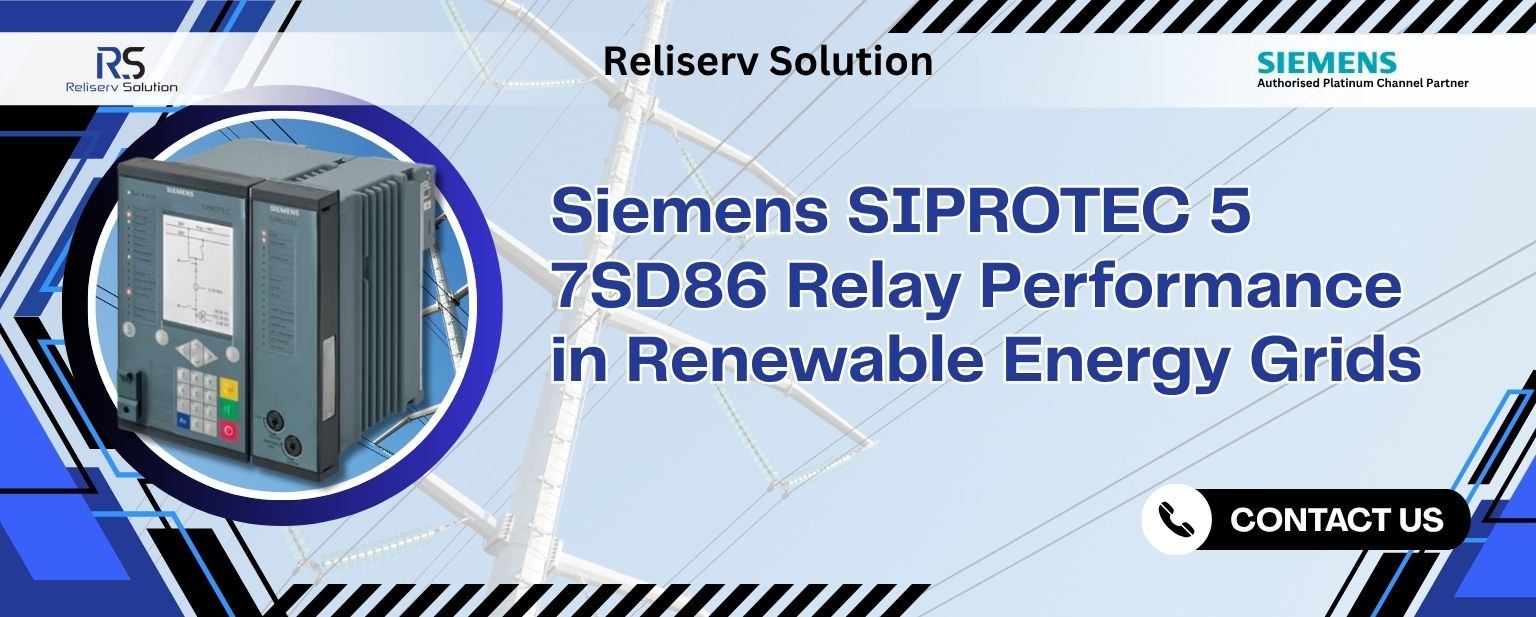
The 7SD86 is a modular line differential protection relay built for medium- and high-voltage transmission networks. It integrates protection, control, automation, monitoring, and power quality functions inside one compact device. Therefore, engineers save panel space while gaining more functionality per unit.
Unlike older electromechanical designs, this relay uses digital differential algorithms. These algorithms compare current at both ends of a line. The relay trips only when a genuine internal fault occurs. Furthermore, it stays stable during external disturbances, which prevents nuisance tripping on healthy circuits. Field engineers appreciate this stability, especially on long renewable feeders with fluctuating load.
Key architectural strengths include:
- Modular and expandable I/O configuration, available in 12 standard variants;
- CT/VT configurations of 4/4 or 8/8 for flexible metering setups;
- Binary inputs ranging from 5 to 31, and binary outputs from 8 to 46;
- Conformal coating that protects internal boards against dust, humidity, and harsh substation air.
This flexible design lets buyers scale the relay to fit project size. It suits both a small wind evacuation feeder and a large transmission corridor. In short, the Siemens 7SD86 Protection Relay adapts to almost any renewable interconnection scenario. Engineers avoid rigid, one-size-fits-all hardware choices, and projects move forward faster as a result.
Why Renewable Grids Need 7SD86 Line Differential Protection
Solar and wind plants inject power in a way that traditional overcurrent relays struggle to interpret. Fault currents from inverter-based resources are often lower and less predictable. Synchronous generators behave very differently under fault conditions. However, 7SD86 Line Differential Protection solves this problem well. It compares current at both line ends instead of relying on fault current magnitude alone.
This method gives the relay near-instant fault recognition. It works regardless of how much current a solar inverter or wind turbine contributes. Additionally, the relay’s adaptive algorithm holds stability during current transformer saturation. This is a common issue on long, heavily loaded renewable feeders that carry variable output throughout the day.
Grid codes across India now demand faster fault clearance to protect sensitive inverter electronics. Not only that, grid operators also need selective tripping. A single fault should never disconnect healthy solar or wind capacity unnecessarily. The Siemens 7SD86 Protection Relay achieves both goals through:
- Tripping times as low as 9 milliseconds for three-pole operation;
- Adaptive differential logic tuned for network disturbance immunity;
- Reliable phase-fault and ground-fault detection across long cable runs.
Communication and Digital Substation Readiness
Modern renewable substations depend on digital communication as much as hardwired signals. The 7SD86 supports IEC 61850 Edition 2, enabling seamless data exchange with other intelligent electronic devices across the substation.
GOOSE messaging provides high-speed peer-to-peer communication, while PRP and HSR redundancy protocols maintain network availability if one communication path fails. This is especially valuable for renewable plants, where downtime directly impacts power generation.
Built-in cybersecurity features, including role-based access control and authenticated communication, help protect against unauthorized changes. In addition, Digital Twin support allows engineers to validate 7SD86 Line Differential Protection settings before commissioning, reducing site testing time, minimizing risk, and accelerating project delivery.
Real-World Performance Benefits for Solar and Wind Projects
When a fault occurs on a feeder connecting a solar park to the grid, every millisecond matters. Delayed clearance can damage inverters and reduce plant availability. It can also trip protective devices unnecessarily. The Siemens 7SD86 Protection Relay minimizes this risk through consistently fast, selective operation across the network.
Wind farms benefit similarly, since turbine generators respond differently to faults than conventional synchronous machines do. Therefore, differential protection that avoids depending heavily on fault current magnitude suits wind evacuation lines particularly well. 7SD86 Line Differential Protection also handles underground cable sections common in solar parks. Capacitive charging current in these cables can otherwise confuse simpler relay schemes.
Plant operators also value the relay’s monitoring and PMU functionality. This data helps engineering teams:
- Track power quality trends across renewable feeders;
- Diagnose intermittent faults before they escalate into outages;
- Plan maintenance windows around actual asset condition, not fixed schedules.
Understanding Siemens 7SD86 Protection Relay Price and Value
Budget planning matters just as much as technical performance for procurement teams. The Siemens 7SD86 Protection Relay Price depends on several factors. These include I/O configuration, CT/VT count, and the communication modules selected. A basic 4/4 configuration naturally costs less than an expanded 8/8 variant with additional binary inputs and outputs.
Buyers should also factor in engineering, commissioning, and DIGSI 5 licensing costs. These add to the overall Siemens 7SD86 Protection Relay Price when compared against competing relay brands in the market. While upfront cost may seem higher than legacy relays, the modular design reduces future upgrade expenses. Consequently, total cost of ownership often favors the 7SD86 over its full service life.
Procurement managers evaluating the Siemens 7SD86 Protection Relay Price should request configuration-specific quotations. Generic list prices rarely reflect actual project needs accurately. Project scale, redundancy requirements, and cybersecurity add-ons all influence the final number significantly. Getting an accurate price early in the design phase helps EPC contractors budget renewable interconnection projects with more confidence.
As a distributor with deep experience in Siemens protection systems, Reliserv Solution helps buyers navigate configuration choices. This guidance happens before buyers commit to a purchase order.
Choosing Trusted Siemens 7SD86 Protection Relay Suppliers
Sourcing genuine hardware matters as much as selecting the right relay model. Working with authorized Siemens 7SD86 Protection Relay Suppliers ensures buyers receive factory-tested units and valid warranties. It also guarantees access to firmware updates. Grey-market units, on the other hand, often lack proper documentation and support entirely.
Reliable Siemens 7SD86 Protection Relay Suppliers also provide application engineering support. They help buyers select the correct I/O count, CT/VT ratio, and communication protocol. This guidance reduces costly redesigns later in the commissioning process, which saves both time and budget.
When evaluating Siemens 7SD86 Protection Relay Suppliers, procurement teams should check for:
- Authorized distributor status directly from Siemens;
- Local stock availability and delivery timelines across India;
- Technical support for DIGSI 5 configuration and commissioning;
- After-sales service for testing, calibration, and firmware upgrades.
Choosing established suppliers protects the long-term reliability of renewable interconnection projects. It also shortens commissioning schedules considerably, which keeps project timelines on track.
Conclusion
Renewable energy grids demand protection relays that combine speed, selectivity, and digital readiness. The Siemens 7SD86 Protection Relay delivers all three through adaptive differential algorithms, modular hardware, and full IEC 61850 support. Its 7SD86 Line Differential Protection capability suits solar parks, wind farms, and transmission corridors carrying variable renewable generation. As renewable capacity keeps expanding across India, this relay gives utilities and EPC contractors a dependable foundation for grid stability.
For engineers, procurement managers, and EPC contractors planning renewable interconnection projects, this relay offers a proven path forward. Reach out to a trusted Siemens partner today. Discuss configuration options and move your next renewable protection project forward with confidence.
Siemens SIPROTEC 5 7SD86 Line Differential Protection Relay Maximizes Performance of Renewable Energy Grids. Engineered for fast fault detection, dependable line differential protection, and seamless integration with modern grid infrastructure, it helps improve system stability, minimize outages, and ensure reliable power transmission from renewable energy sources. At Reliserv Solution, a Platinum Channel Partner of Siemens, we provide advanced protection and automation solutions tailored to renewable energy, utility, and industrial power systems. Call us at +917506112097 or email [email protected] for expert guidance and support. Click here to explore the Siprotec 5 Relays and discover how it enhances the performance, reliability, and resilience of renewable energy grids.